Structured 12.66 km Exercise on an Undulating Route
A structured 12.66 km exercise on an undulating route, combining walking, jogging and running with four repeated running kilometres between 4:45 and 4:47/km.
A Structured 12.66 km Exercise on an Undulating Route
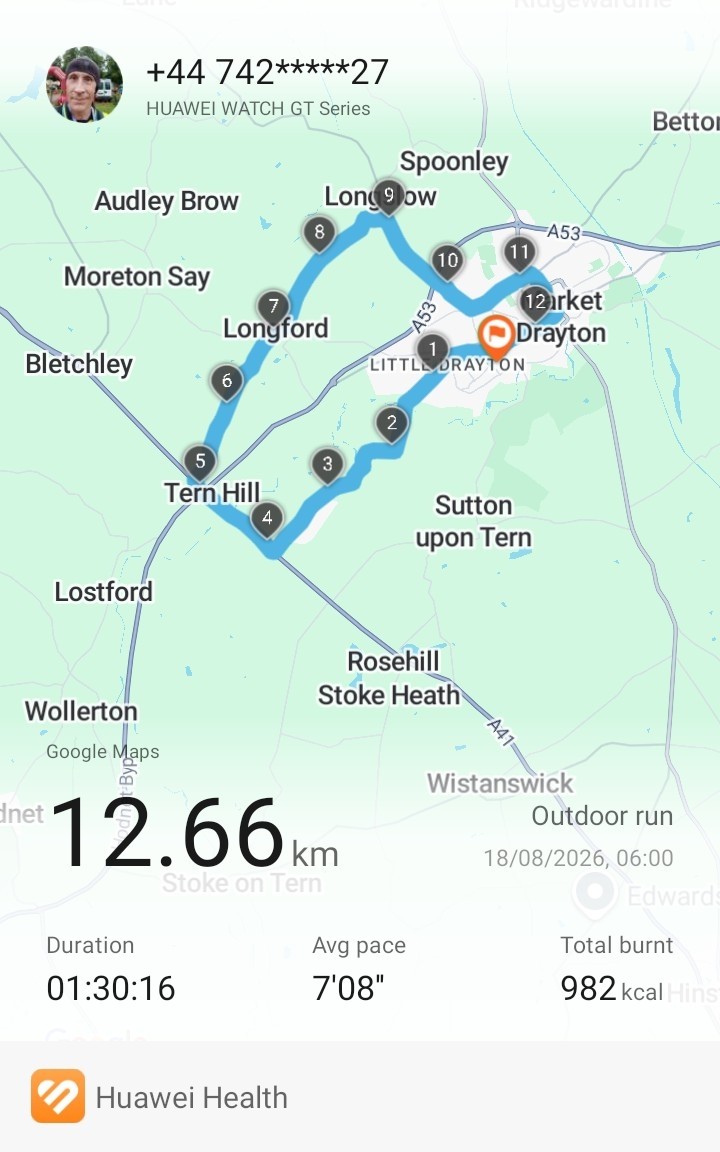
This morning’s exercise covered 12.66 km in 1 hour 30 minutes 16 seconds, with an average pace of 7:08/km and an average heart rate of 122 bpm. It was a different route from some of my recent sessions, with an undulating profile and several good uphill sections.
The important point for me is that I regard the entire 12.66 km as the exercise. The walking, jogging and running are all part of the session rather than treating the running sections as the only part that counts.
A Deliberately Structured Session
I try to approach these sessions with some discipline rather than simply walking out of the front door and immediately starting to run. The session began with a warm-up, followed by alternating running and recovery sections, before finishing with a walk.
There are runners who can step straight out of their front door and start running, complete their distance and run straight back home. That approach can work for them, but it isn’t how I prefer to exercise.
I would rather give the session some structure and allow the intensity to change during the 12.66 km. The slower sections are not wasted distance. They provide recovery and make it possible to include faster running without turning the whole exercise into a continuous hard effort.
The Running Sections
The first running kilometre came at 5:20/km. After that, the pace became remarkably consistent:
- 4 km – 4:47/km
- 6 km – 4:45/km
- 8 km – 4:47/km
- 10 km – 4:46/km
What makes those figures more interesting is the route. The 4:47/km and 4:45/km kilometres were both climbs, so they were not simply fast kilometres produced by a flat or downhill section.
Maintaining 4:45–4:47/km on those efforts was therefore a useful part of the session. More importantly, the pace did not progressively slow as the exercise continued.
Recovery Was Part of the Plan
The running sections were separated by controlled jog/walk periods:
- 3 km – 8:20/km
- 5 km – 8:18/km
- 7 km – 8:20/km
- 9 km – 8:10/km
- 11 km – 8:28/km
After the final running section at 10 km, I continued with a 9:03/km walk for the 11th kilometre, followed by another 660 metres at 6:02/km.
This means the session wasn’t simply five isolated fast kilometres. The slower sections were what allowed those running efforts to be repeated while keeping the overall exercise controlled.
Heart Rate and Training Load
The overall average heart rate was 122 bpm, with a maximum of 162 bpm. The exercise recorded 862 calories and included 14 minutes in the extreme zone, 11 minutes anaerobic, 17 minutes aerobic and 41 minutes in the fat-burning zone, plus four minutes of warm-up.
Those figures reflect the mixed nature of the session. The overall 12.66 km average pace of 7:08/km includes everything: warm-up, walking, recovery, running and the final cool-down.
The Whole 12.66 km Counts
At 58, I’m increasingly interested in how the whole session is structured rather than simply asking how fast I can run from the moment I leave home.
For me, there is value in being able to cover a substantial distance while deliberately changing the intensity. A controlled warm-up, faster running, recovery, walking and a cool-down can all have a place in the same exercise.
Today’s 12.66 km was therefore not a failed continuous run or five intervals surrounded by walking. It was a complete 90-minute exercise, deliberately structured around the terrain and the way I wanted to use the route.
The standout feature was the repeatability of the faster running: four kilometres between 4:45 and 4:47/km, including uphill sections. But those figures only make sense when viewed as part of the complete 12.66 km.