Walk, Run, Recover: What My Morning Exercise Has in Common With Racehorse Training
A 10km walk-run workout with progressively faster running efforts got me thinking about racehorse training. The walking recovery isn’t wasted time — it’s part of the workout.
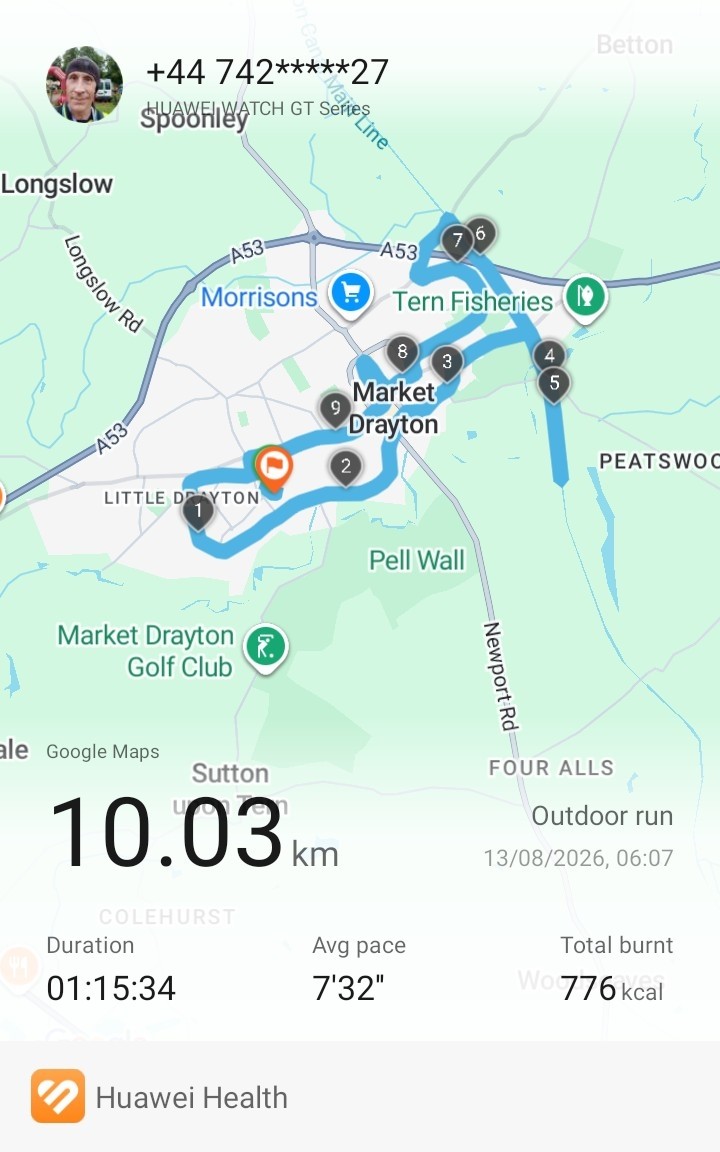
This morning’s 10.03 km session wasn’t a continuous run. It was a mixture of walking, running and recovery — and it got me thinking about something I’ve seen countless times in racehorse training.
Racehorses are often trained through repeated pieces of work rather than simply being asked to gallop continuously. A horse might go four or five furlongs up the gallop, return to the start, recover, and then go again at a different pace. Sometimes the recovery is active rather than complete rest.
My session followed a surprisingly similar principle.
The Session
The workout lasted 1 hour 15 minutes 34 seconds and covered 10.03 km.
- Average pace: 7:32/km
- Average heart rate: 122 bpm
- Maximum heart rate: 166 bpm
- Calories: 776 kcal
The structure was straightforward:
- 1K walk — 9:56
- 1K run — 5:18
- 1K walk — 9:02
- 1K run — 5:06
- 1K walk — 8:59
- 1K run — 4:42
- 1K walk — 8:38
- 1K run — 4:33
- 1K walk — 9:08
- 1K walk — 9:48
There was also another 30 metres of walking at the end.
The Running Got Faster
The most interesting part of the session wasn’t the overall 7:32/km pace. It was what happened during the four running efforts.
5:18 → 5:06 → 4:42 → 4:33/km
Each running section was faster than the previous one.
That meant I wasn’t trying to maintain one hard pace for the entire workout. Instead, I was using the walking sections to recover before another effort.
The Walking Is Part of the Training
It would be easy to look at the session and say that roughly six kilometres were walking.
But that misses the point.
The walking was active recovery. I wasn’t stopping and sitting down. I was continuing to move, allowing my heart rate and breathing to settle before starting another faster effort.
That also explains why an overall pace of 7:32/km is quite respectable. The walking kilometres were mostly around nine minutes per kilometre, while the running kilometres were between 4:33 and 5:18.
The average therefore reflects a mixture of two very different speeds.
What Racehorse Training Has in Common
This is where the comparison with racehorse training becomes interesting.
A racehorse doesn’t necessarily gallop flat-out from beginning to end of every training session. Trainers can use different pieces of work at different speeds, with recovery between them.
The recovery period isn’t wasted time. It allows another piece of work to be completed with a different level of effort.
In some forms of training, the horse may return to the start and walk or jog before doing another piece. The workload is therefore made up of repeated efforts rather than one continuous maximum effort.
My session is obviously nowhere near the demands placed on a racehorse, but the underlying principle is similar: work, recover, work again, and vary the intensity.
Why I Like This Type of Exercise
For me, this approach makes a long session more manageable.
I can accumulate a substantial amount of movement and distance without having to run continuously for 75 minutes. At the same time, the faster running sections provide a much greater stimulus than simply walking for the entire distance.
The result was 10.03 km of movement, four proper running efforts and plenty of active recovery.
And perhaps the best indication that the session was working was the final running kilometre.
4:33/km was the fastest of the four.
I finished the faster work with something left rather than slowing down progressively as the session went on.
It’s Not Always About Running Continuously
There is sometimes an assumption that a good running workout means running continuously for a long distance.
It doesn’t have to.
Walking and running can be combined to create a demanding and useful workout. The recovery periods make it possible to introduce faster efforts while still spending a long time exercising.
That’s one of the things I find interesting about exercise: sometimes the most useful lesson isn’t about going harder. It’s about understanding how to structure the work.
Work. Recover. Go again.
Racehorse trainers have been using variations of that principle for a very long time. There’s probably something worth learning from it for human exercise too.